A pool heater is the difference between a two-month swim season and a six-month one. It is also one of the purchases where homeowners most consistently underestimate the full cost by focusing on the unit price and ignoring the installation variables that can easily double or triple the sticker number. Whether you are choosing between a gas heater, a heat pump, or a solar system, what you pay comes down to heater type, pool size, your existing infrastructure, and the specific labor requirements of your installation.
This guide breaks down every cost component, gives you realistic ranges by heater type, and explains what actually drives those numbers so you can evaluate quotes with confidence.
The Short Answer: What Pool Heater Installation Costs
Pool heater installation costs range from $1,500 on the low end for a basic electric resistance heater on a small pool to $12,000 or more for a full solar heating system on a large pool that requires new plumbing runs and structural roof work.
The national average for a standard gas heater or heat pump installation lands between $3,000 and $5,500 installed, including the unit and labor.
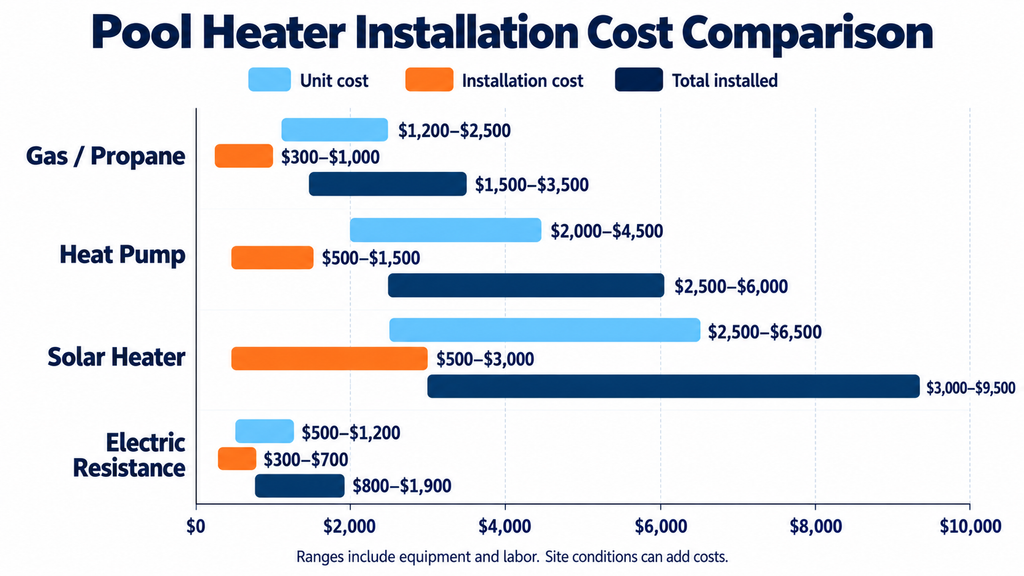
| Heater Type | Unit Cost | Installation Cost | Total Installed Range |
| Gas / Propane | $1,200 to $2,500 | $300 to $1,000 | $1,500 to $3,500 |
| Heat Pump | $2,000 to $4,500 | $500 to $1,500 | $2,500 to $6,000 |
| Solar Heater | $2,500 to $6,500 | $500 to $3,000 | $3,000 to $9,500 |
| Electric Resistance | $500 to $1,200 | $300 to $700 | $800 to $1,900 |
These ranges assume the necessary gas lines, electrical circuits, or plumbing runs are already in place. If any of those require new work, the costs increase accordingly.
For a proper assessment and installation by a team that works specifically with pool systems, The Pool Specialist handles Pool heater installations across all heater types and can identify what your specific setup requires before any equipment is purchased.
The Four Types of Pool Heaters and What Each Costs
Gas Pool Heaters
Gas heaters are the most popular choice for pool heating in North America, primarily because they heat water fast regardless of outside air temperature. A 400,000 BTU gas heater can raise pool temperature by several degrees in a matter of hours. They work equally well in cold weather, making them the only realistic option for year-round swimming in northern climates.
Unit cost: $1,200 to $2,500 depending on BTU output. A 200,000 BTU unit handles pools up to about 15,000 gallons. A 400,000 BTU unit covers larger pools or situations where faster heating is a priority.
Installation cost: $300 to $1,000 for a straightforward replacement or new install where a gas line already reaches the equipment pad.
Additional costs that apply to many installations:
- New gas line run from main: $200 to $1,500 depending on distance
- Gas meter upgrade if existing meter capacity is insufficient: $150 to $400
- Propane tank installation (if not on natural gas): $400 to $2,000
- Exhaust venting requirements: $200 to $600
- Permits: $50 to $400 depending on jurisdiction
A realistic total for a first-time gas heater installation with no existing gas line at the equipment pad: $2,500 to $5,000.
Operating cost: Gas heaters are the most expensive to run. Natural gas rates vary significantly by region, but most pool owners using a gas heater actively to maintain 80 to 84 degrees spend $200 to $400 per month during the heating season. Propane is consistently more expensive per BTU than natural gas.
Heat Pump Pool Heaters
Heat pumps do not generate heat. They extract ambient heat from outdoor air and transfer it to pool water using refrigerant and a compressor. Because they move existing heat rather than creating it from combustion, they are three to five times more energy-efficient than gas heaters.
The trade-off is that heat pumps are dependent on outdoor air temperature to function efficiently. Most operate at full efficiency above 50 degrees Fahrenheit. Below 50 degrees, efficiency drops. Below 40 degrees, most units stop operating. For pools in climates with mild winters, this is rarely an issue. For pools in cold-climate states where the goal is year-round swimming, a heat pump alone typically cannot deliver that.
Unit cost: $2,000 to $4,500 for residential units. Units are rated by BTU output and COP (Coefficient of Performance), which measures energy output per unit of energy consumed. A COP of 5.0 means the unit produces 5 BTUs of heat for every 1 BTU of electricity consumed.
Installation cost: $500 to $1,500. Heat pumps require a dedicated electrical circuit, typically 240V/50A or 60A. If the pool equipment pad does not already have an appropriate electrical supply, running a new circuit from the main panel is the primary labor variable.
- New electrical circuit: $300 to $800 depending on distance from panel
- Panel upgrade if required: $800 to $2,500
- Permits: $50 to $400
Operating cost: $50 to $150 per month during active heating periods, depending on target temperature, climate, and whether a solar cover is used. The higher upfront cost relative to a gas heater is consistently recovered in operating savings over three to five years for pools that heat regularly.
Solar Pool Heaters
Solar pool heaters use roof-mounted or ground-mounted collector panels to capture solar energy and transfer it to pool water circulated through the panels by the existing pool pump. There are no fuel costs once the system is installed, making them the cheapest to operate over a long time horizon.
The cost variables for solar heating are wider than any other heater type because the project often involves roof work, dedicated plumbing runs, and structural assessment.
Unit cost: $2,500 to $6,500 for residential panel systems, depending on the number of panels required. Sizing is based on pool surface area. A general rule of thumb is 50 to 100 percent of pool surface area in solar collector panel area, with the higher end needed for year-round heating in partially shaded or less sunny locations.
Installation cost: $500 to $3,000 depending on:
- Roof access and condition (new penetrations, flashing, rafter clearance)
- Distance from roof to equipment pad for plumbing runs
- Whether an automatic valve and controller are included
- Ground-mount framing if roof installation is not viable
Limitation: Solar heaters extend the swim season effectively in sunny climates but cannot maintain pool temperatures during cold weather or overcast stretches without a backup heater. They are most cost-effective as a primary heater in Sun Belt climates and as a supplemental system everywhere else.
Operating cost: Effectively zero beyond the electricity already used to run the pool pump, which circulates water through the panels.
Electric Resistance Heaters
Electric resistance heaters convert electricity directly to heat using heating elements, similar to an electric oven. They are inexpensive to purchase and install, have no combustion requirements, and work independently of outdoor temperature.
The problem is operating cost. Electric resistance heating is the least efficient method of pool heating available. They consume large amounts of electricity to produce heat, making them practical only for very small pools, spas, or situations where heating is used infrequently.
Unit cost: $500 to $1,200
Installation cost: $300 to $700
Operating cost: Considerably higher than heat pumps for equivalent heating output. Rarely recommended for full-size pools if any other option is viable.
Installation Factors That Change Your Total Cost
Replacing an Existing Heater vs. New Installation
Replacing a heater that is at the end of its service life is significantly cheaper than a first-time installation. The gas line, electrical circuit, plumbing connections, and equipment pad already exist. The new heater drops in on the existing infrastructure.
Replacement typically reduces installation labor to $200 to $600. The main variables are whether the new unit requires a larger gas line, different venting configuration, or upgraded electrical supply compared to the old unit.
First-time installations carry the full cost of running whatever utilities the heater type requires from their source to the equipment pad.
Pool Size and BTU Requirements
Undersizing a heater is one of the most common and costly mistakes in pool heater purchases. A heater that is too small for the pool volume and the desired temperature increase will run constantly, wear out prematurely, and still fail to reach target temperatures during cold weather.
Proper sizing accounts for:
- Pool volume in gallons
- Desired temperature rise (the difference between average coldest expected temperature and target pool temperature)
- Climate and wind exposure, which affects heat loss rate
- Whether a solar cover is used (covers dramatically reduce required BTU output by preventing evaporative heat loss)
Most residential pools between 10,000 and 20,000 gallons are well-served by a 300,000 to 400,000 BTU gas heater or a heat pump in the 120,000 to 140,000 BTU range. Oversizing slightly is preferable to undersizing for both comfort and equipment longevity.
Permits and Inspections
Most jurisdictions require permits for pool heater installations, particularly gas and electrical connections. Permit costs range from $50 to $400 and typically include an inspection at completion. Gas installations specifically may require a pressure test of the gas line. Skipping the permit creates liability at resale and can void equipment warranties.
Any pool specialist pulling proper permits includes this in their scope. Be cautious of contractors who suggest skipping permits to reduce project cost.
Existing Infrastructure
The single biggest variable in pool heater installation cost after the unit itself is what infrastructure already exists at the equipment pad:
- Gas line at pad already? Installation is straightforward.
- No gas at pad? Add $200 to $1,500 for line extension.
- Correct electrical circuit? Heat pump installs cleanly.
- No 240V circuit at pad? Add $300 to $800 for new circuit.
- Roof access for solar? Affects labor significantly.
Get these questions answered before any quote is finalized. The unit cost is usually the smaller variable in what separates a $2,000 installation from a $5,000 one.
Operating Cost Comparison Over 10 Years
| Heater Type | Installation Cost | Annual Operating Cost (Avg) | 10-Year Total |
| Gas (Natural Gas) | $2,500 to $4,500 | $1,200 to $3,600 | $14,500 to $40,500 |
| Heat Pump | $3,000 to $6,000 | $600 to $1,800 | $9,000 to $24,000 |
| Solar | $4,000 to $9,500 | $0 to $200 | $4,200 to $11,500 |
| Electric Resistance | $800 to $1,900 | $2,000 to $5,000 | $20,800 to $51,900 |
These figures assume regular use during a typical swim season and should be treated as directional rather than precise, given the variation in energy rates, climate, and usage patterns. The pattern they reveal is consistent: heat pumps and solar systems have higher upfront costs and substantially lower lifetime costs than gas or electric resistance heating.
Signs You Need a New Heater vs. a Repair
Before budgeting for a full replacement, it is worth understanding whether a repair is viable. Pool heaters have service lives of roughly:
- Gas heaters: 7 to 15 years
- Heat pumps: 10 to 20 years
- Solar systems: 15 to 25 years
Signs that lean toward replacement rather than repair:
- Unit is more than 75% through its expected service life
- Repair cost exceeds 50% of the cost of a comparable new unit
- Heat exchanger failure (the most expensive component to replace)
- Repeated repairs to the same system within a short period
- Unit’s efficiency has declined noticeably with age
Signs that lean toward repair:
- Unit is relatively new
- Problem is a specific component (ignitor, pressure switch, thermostat)
- No evidence of heat exchanger or refrigerant system failure
What to Ask Before Accepting a Quote
When getting quotes for pool heater installation, ask each contractor:
- Is the unit properly sized for my pool volume and climate?
- What existing infrastructure do you need to verify before finalizing the cost?
- Does the quote include permits and the inspection?
- What warranty does the unit carry, and what labor warranty do you provide?
- Is the quote for a straight replacement, or does it include any infrastructure work?
- What would add cost after the project begins?
That last question reveals the quality of the estimate. A contractor who gives a fixed price after seeing the equipment pad and existing utilities has done the work of a real quote. A contractor who gives a number before seeing the site is giving you a unit price, not an installation price.
The Bottom Line
Pool heater installation costs between $1,500 and $9,500 for most residential installations, with the total driven primarily by heater type and the infrastructure work required at the equipment pad. Gas heaters cost the least upfront and the most to operate. Heat pumps cost more upfront and significantly less to run over time. Solar systems have the highest installation cost and the lowest lifetime operating cost. Electric resistance heaters are cheap to install and expensive to operate consistently.
Get at minimum two written quotes that specify the exact unit model, BTU rating, what infrastructure work is included, and whether permits are handled. The gap between those quotes will tell you more about the project than any online estimate.